Surviving the 2026 Classroom: Teachers or Digital Mentors?
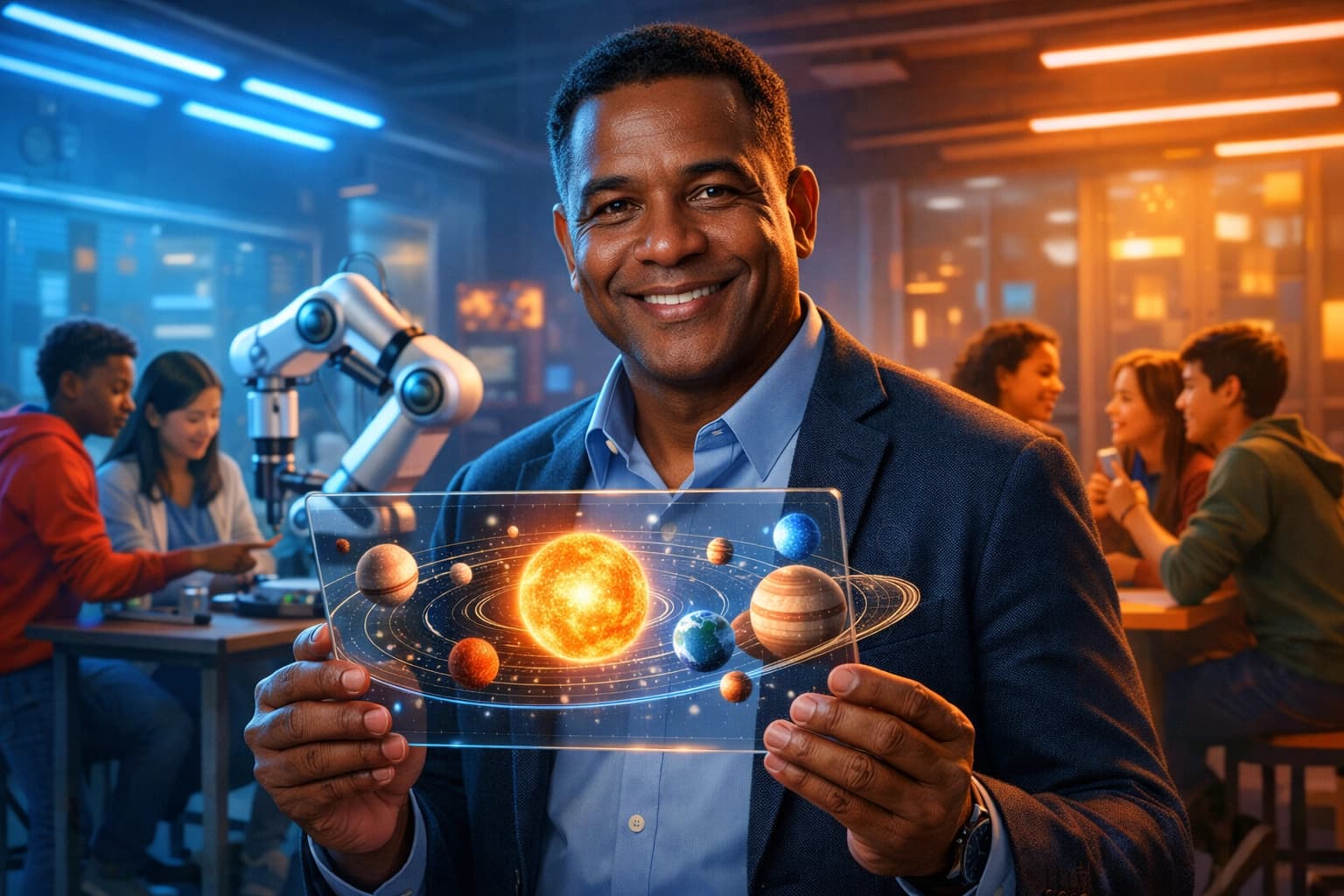
Welcome back to the ideas lab, colleagues! Whether you are reading this on your mixed-reality contact lenses or your trusty old tablet, welcome.
It feels like only yesterday we were talking about ChatGPT as the "next big thing" back in 2023, doesn't it? Now, in the heart of 2026, the educational landscape has shifted drastically. ICTs (Information and Communication Technologies) are no longer an "add-on"—they are the oxygen of the classroom. But with great (processing) power comes great responsibility.
Today, we are breaking down the major challenges we STEAM educators face in this new year.
Metaverse Fatigue" and Mixed Reality
Two years ago, everyone wanted VR headsets in class. Today, the challenge is balance. Our students spend hours in immersive environments outside of school.
- The Challenge: Ensuring technology in the classroom is a tool for active creation, not just passive consumption.
- The Goal: Use Augmented Reality (AR) to dissect virtual frogs or visit Mars, but knowing exactly when to power down and touch the earth (literally—let’s get out into the school garden!).
AI as a Co-pilot, Not Autopilot
We’ve moved past the fear of AI "doing the homework." Now the problem is more subtle: critical thinking atrophy.
- The Challenge: Students get perfect answers in microseconds. Our job is no longer to evaluate the answer, but to evaluate the prompt they wrote and how they verified that info.
- The STEAM Strategy: Fewer rote-memory exams, more problem-solving projects where AI is just another tool, like a calculator.
Digital Divide 2.0: Hardware vs. Neural Connectivity
While devices are cheaper, the gap has shifted to speed and access to premium tools.
Profe's Note: It’s no use having a top-of-the-line 3D printer if the modeling software requires a subscription the school can’t afford. Tech equity remains our primary battle in 2026.
Humanizing the Code (Ethics in STEAM)
In 2026, teaching how to code is easy. Teaching technological ethics is the hard part.
- Should we program that drone for surveillance?
- How do our algorithms impact minorities? This year’s STEAM approach must carry a giant "H" for Humanities. We need "Philosopher Engineers."
Profe Xenón’s Conclusion
The challenge of 2026 isn't learning to use the newest trendy tool (another one will drop tomorrow). The challenge is maintaining the human connection in a hyper-digitalized environment. We are the curators of knowledge, the guides through the information storm.
Keep it up, teachers! If we survived the pandemic and the rise of generative AI, we can handle this. Let’s get those neurons firing!